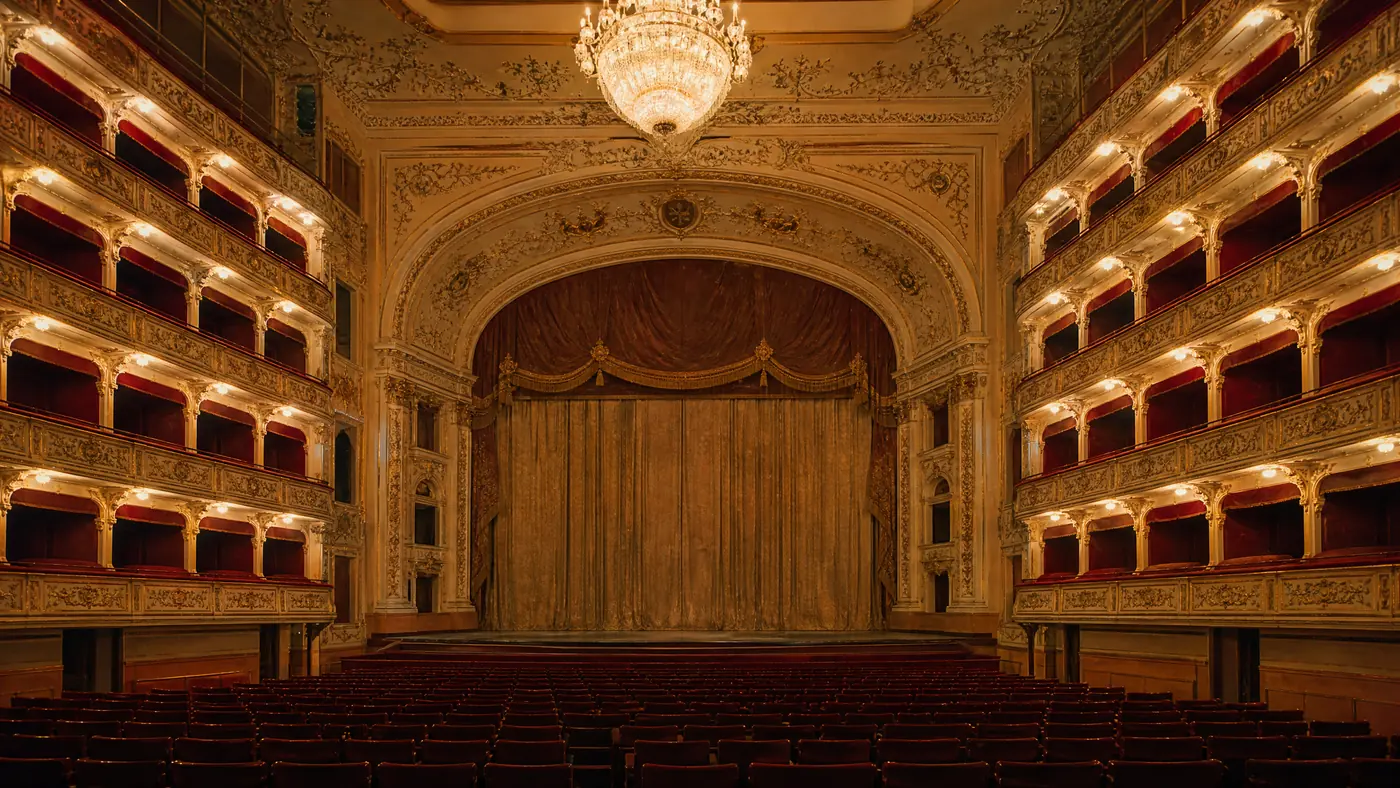
Booking choice: The House of Music guided tour, from $13 per person. Check dates Tour details
The House of Music Hungary (Magyar Zene Háza) stands at Olof Palme sétány 3-5, beside the City Park lake and close to Vajdahunyad Castle. Walk in and the building costs nothing to explore. The foyer under the golden ceiling is open to anyone; tickets are only for the exhibitions, the Sound Dome, concerts and programs.
This guide covers the architect and the competition, the timeline from 2014 to the opening in 2022, the roof and its light wells, the leaf ceiling and the glass walls, the three levels, the cooling trick borrowed from the ice rink next door, the awards, and the easiest way into the concert hall when nothing is on.
The quick answer
The House of Music Hungary was designed by the Japanese architect Sou Fujimoto, who won the design competition in December 2014. It opened on 22 January 2022, the Day of Hungarian Culture. Its undulating roof, inspired by the vibration of sound, is pierced by exactly 100 light wells, and the foyer ceiling is covered in golden leaves. The guided tour takes you into the concert hall and the lecture hall.
Who designed the House of Music Hungary?
Sou Fujimoto, a Japanese architect born in 1971 who set up his own office in 2000. He won the design competition, one of four held at the same time for the Liget Budapest Project.
Fujimoto was born in Hokkaido in 1971, graduated in 1994 and founded Sou Fujimoto Architects in 2000, according to Wikipedia. He is known for light structures and permeable walls. In 2013 he designed the temporary Serpentine Gallery pavilion in London, and his housing tower L'Arbre Blanc stands in Montpellier. Wikipedia lists the House of Hungarian Music, Budapest, 2022 among his main works.
The commission came out of the Liget Budapest Project, the renewal of City Park as a cultural district. Hungarian Wikipedia dates the result of the House of Music competition to December 2014. Architectural Record notes it was one of four competitions run side by side for the project. Another of them produced the Museum of Ethnography by NAPUR Architect, a few minutes away on foot.
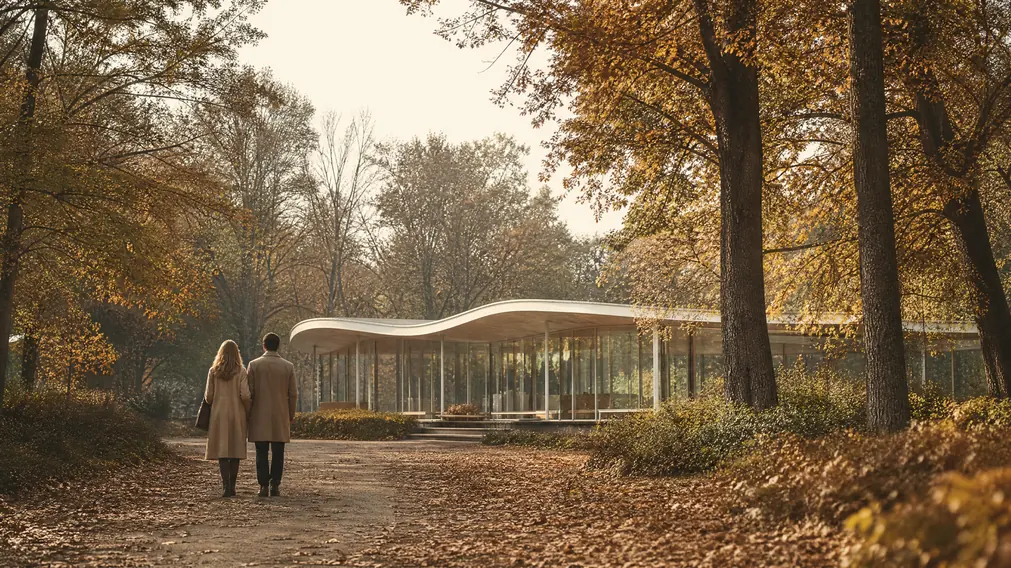
His starting point was the park itself. Hungarian Wikipedia sums up the brief he set himself: a harmony of the built and the natural, a place where music and nature meet. Wallpaper quotes him on the plan: "I envisaged the open floor plan, where boundaries between inside and outside blur."
When was the House of Music built and opened?
Construction was announced in August 2018, the structure was finished in summer 2020 and the House opened to the public on 22 January 2022.
The site was not empty park. Hungarian Wikipedia says the House rose where the 1960s Hungexpo offices had stood, on a fenced-off plot of about 10,000 square meters. The three-level building takes a third of it; the rest was planted again as park. The contractor was Magyar Építők.
| Date | What happened | Source |
|---|---|---|
| December 2014 | Result of the design competition; Fujimoto wins | Hungarian Wikipedia |
| 2015 | First images of the design are published | Hungarian Wikipedia |
| August 2018 | Construction is announced | Hungarian Wikipedia |
| 2019 | International Property Awards: Best International Public Service Architecture | Liget Budapest |
| Summer 2020 | The structure is complete | Hungarian Wikipedia |
| 16 December 2021 | Technical handover | Hungarian Wikipedia |
| 22 January 2022 | Opening to the public on the Day of Hungarian Culture | Hungarian Wikipedia |
| 19 February 2022 | First world premiere in the building, a work by András Derecskei | Hungarian Wikipedia |
The opening day had a soundtrack. Students of the Liszt Academy gave a huge concert in the building, Hungarian Wikipedia records, and the program started the next day. The permanent exhibition, Dimensions of Sound (Hangdimenziók), opened with it.
The official guided tour starts in the entrance hall and spends an hour on the building, the concert hall and the lecture hall, in groups of up to 15.
Check dates for the House of Music guided tourWhy does the House of Music roof have 100 holes?
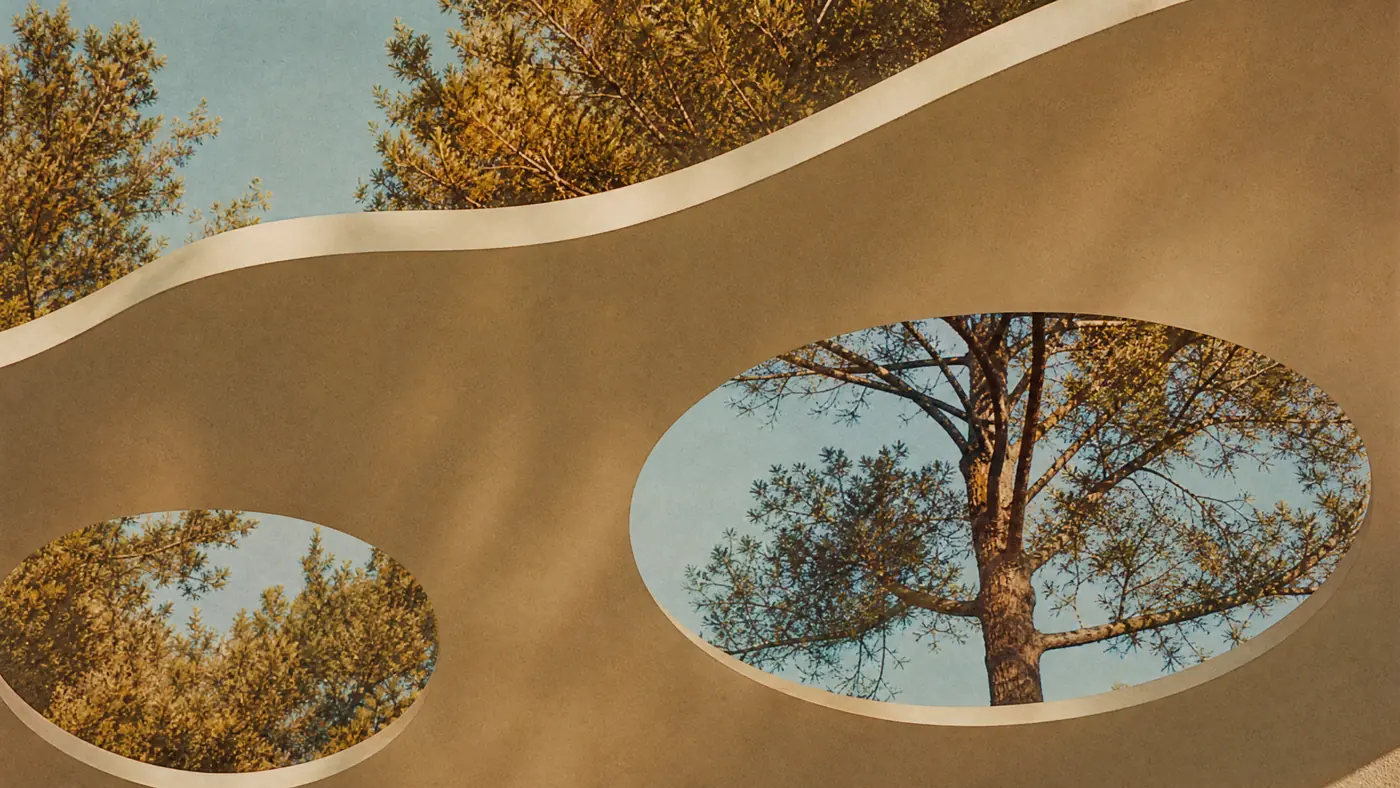
They are light wells. The roof waves like the vibration of sound, and its exactly 100 openings bring daylight down into the building, some of it as far as the lowest exhibition level.
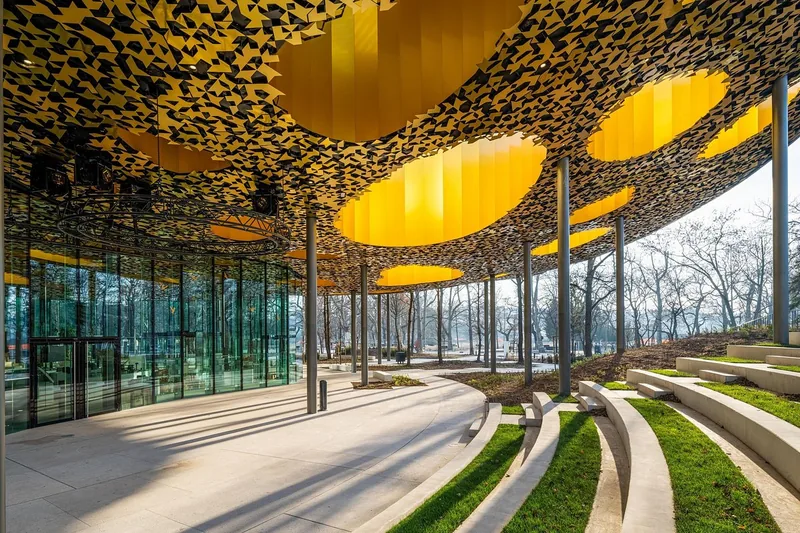
Liget Budapest, which runs the City Park project, says it counted them: exactly 100 holes, each one a different shape. Some are round, some more angular, and they vary in size. They earned the name light wells because they pull daylight into the House, and a few channel it all the way to the underground exhibition space. Trees grow up through some of them.
The wave is the idea. The roof's movement was inspired by the vibration of sound, Liget Budapest explains, and the monumental glass walls under it are so clear that the roof seems to float among the treetops. People have called it a mushroom, a pancake and a cheese. Liget adds, with a straight face, that some visitors reported a UFO.
Architectural Record looked at the structure. The roof is up to about 7 m deep in places and thins to a few centimeters at the edges, and it reaches out past the walls the way many traditional Japanese roofs do. That magazine counted 145 openings, because it included the scalloped cutouts that wrap around trees at the edge and the entry plaza. Liget Budapest's own figure for the light wells is exactly 100. Fujimoto told it why none is a neat circle: "Pure circles are too artificial."
What is the golden ceiling of the House of Music made of?
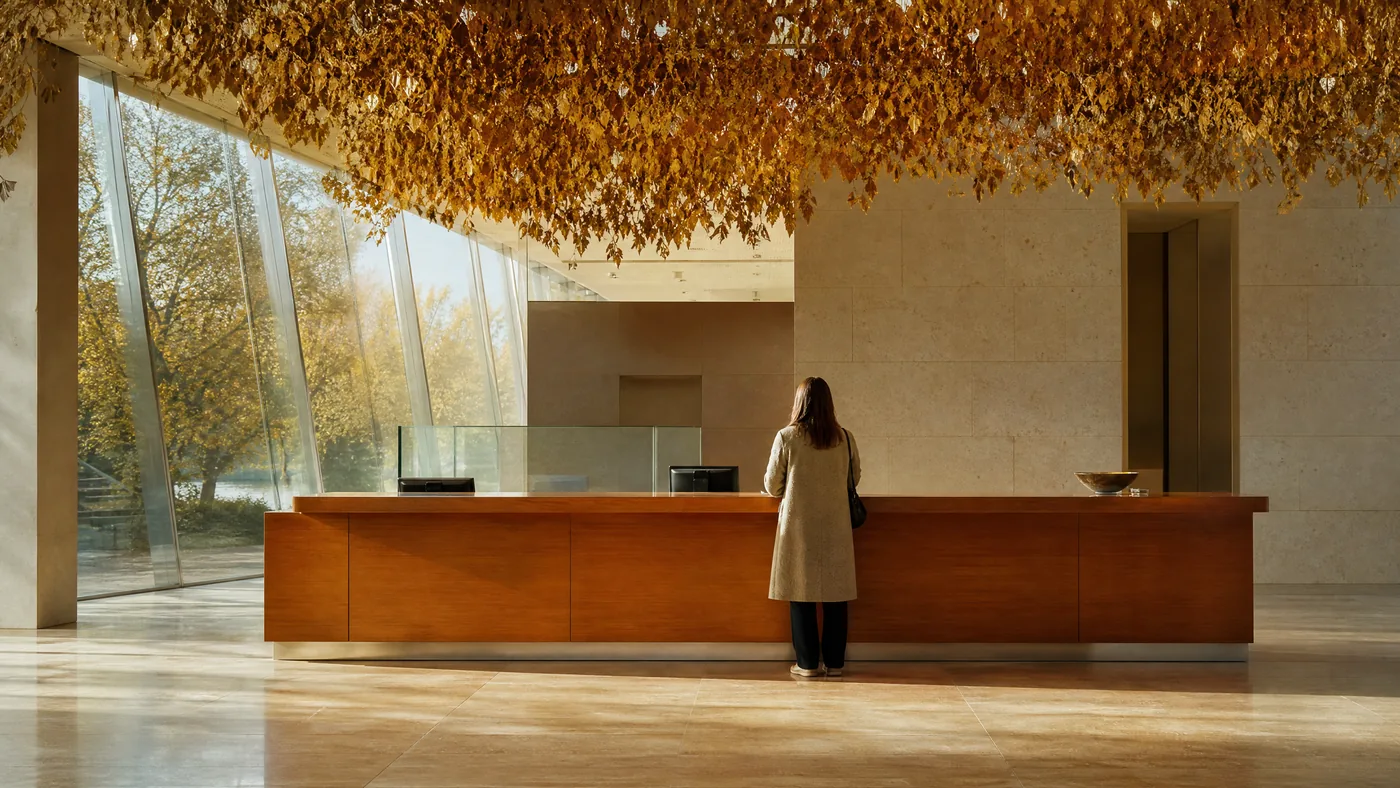
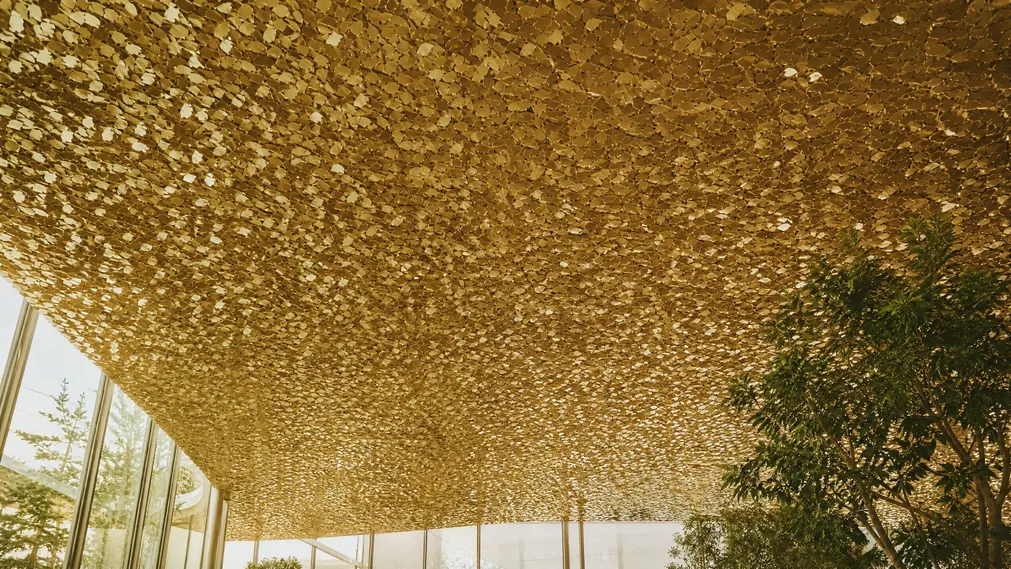
About 30,000 leaves of aluminum composite in three shades of gold, hung from a steel honeycomb. Seen with the glass walls, they make the foyer feel like a forest floor.
Step inside and the ceiling takes over. Liget Budapest describes a golden ceiling with a leafy design that blends with the almost invisible glass walls, so you feel you are still walking under the trees with golden light sifting through. The park level is meant for sitting, not just passing through.
The numbers come from the design press:
- The leaves: about 30,000 abstract leaves in aluminum composite, in three shades of gold (Architectural Record); Wallpaper gives the same count.
- The frame: a steel structure of some 1,000 honeycomb-shaped elements holds them (Wallpaper).
- The acoustics: the black gaps between the leaves hide sound-absorbing material (Architectural Record).
- The glass: the outer walls use 94 fixed insulated glass panels (Architectural Record), up to about 12 m high in places (Wallpaper).
The gold is a nod to Budapest. Architectural Record says it draws on the gilded surfaces of the Liszt Academy, the city's great Art Nouveau concert hall. Fujimoto put it simply: "Gold creates special, ceremonial moments in the evening." Come back after dark for a concert and you see what he meant.
The House's own one-hour tour, run by Liget Budapest: the entrance hall, the concert hall and the lecture hall, with the story of the building. Wheelchair and stroller accessible; exhibition entry is separate.
Explore the House of Music guided tour Tour detailsWhat is on each level of the House of Music?
Exhibitions and the Sound Dome underground, concerts at park level with an open-air stage outside, and music education and the library on the top floor.
Hungarian Wikipedia describes a building in three parts, and Liget Budapest's floor guide fills in the rooms. A spiral staircase, which Liget calls a work of art in itself, links the park level with the exhibitions below.
| Level | What is there | Ticket? |
|---|---|---|
| Upper floor, the "cap of the mushroom" | Music education spaces, the Multimedia Library and Club | Workshops ticketed |
| First floor | The café, among the treetops | No |
| Park level | Foyer under the golden ceiling, concert hall, lecture hall, Trilla Bistro, shop, Music Playground; open-air stage outside | Foyer free; concerts ticketed |
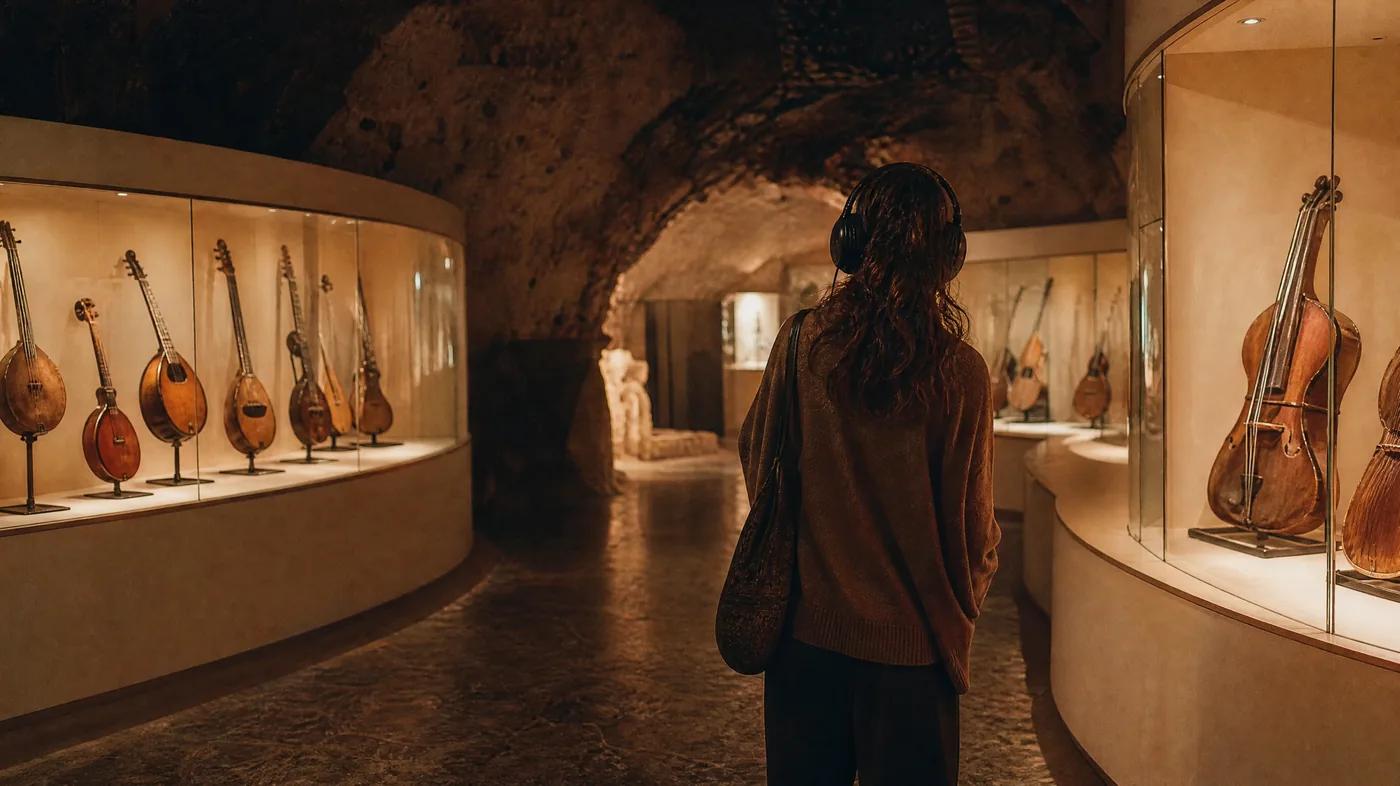
| Underground | Dimensions of Sound, Freddie - The Exhibition, the Sound Dome, the Creative Sound Space | Yes, separate tickets |
The halls are the part most visitors never see. Architectural Record gives the concert hall 320 seats and the lecture hall 100. The concert hall sits behind full-height faceted glass held by glass mullions, with a second layer of glass behind the stage that reflects sound and can be tuned with roll screens, plus blackout curtains for daylight. Wallpaper credits the acoustics to Nagata Acoustics.
Two small details from Liget's guide: turn right at the entrance for the "pyramid of rest", a stepped wall you can sit on, and look up from the café, which Liget calls the most atmospheric in City Park, within arm's reach of the leaves outside. Our exhibition guide covers the underground floor in detail.
How is the House of Music cooled?
With help from the City Park Ice Rink next door. Hungarian Wikipedia says the rink helps cool the building, and its energy comes largely from renewable sources.
This is the detail architecture fans like best. The House stands near the ice rink building on the City Park lake, and Hungarian Wikipedia reports that the rink is used to keep the House cool, with most of the energy from renewables. Wallpaper mentions geothermal sources among the energy strategies. Hungarian Wikipedia adds that the BREEAM building rating system judged the construction work exemplary on environmental grounds.
The neighbor has a long history of its own. Wikipedia dates the City Park Ice Rink to an official opening on 29 January 1870, on part of the lake. Its neo-baroque main building, by Imre Francsek, went up in 1893. The skating surface covers about 12,000 square meters of artificial ice, cooled by roughly 210 km of pipes; in summer the same ground fills with water as a boating lake.
Green was the point from the start. Hungarian Wikipedia describes the building's main message as being woven into nature, with rooms that let air, light and music flow freely.
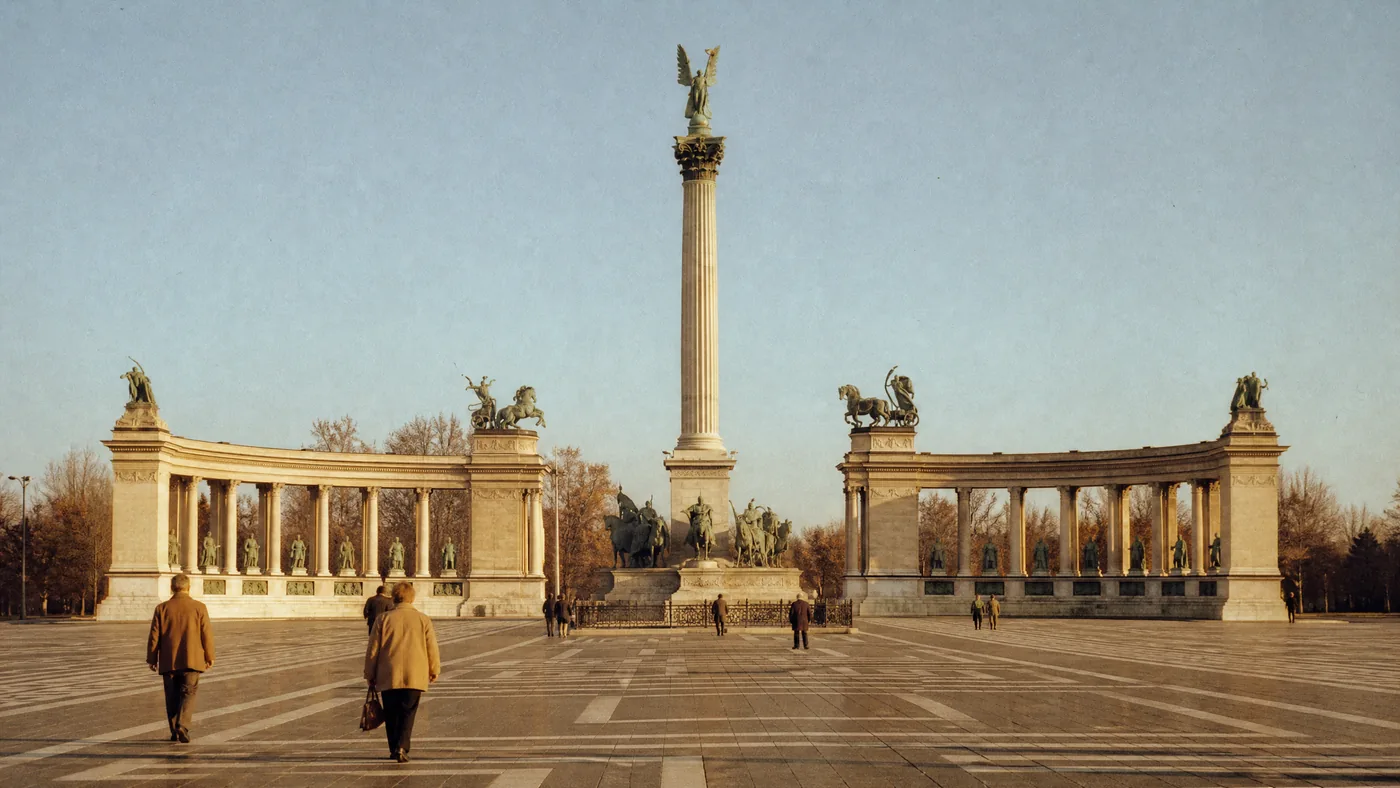
The Heroes' Square and City Park walk stops at the House of Music for photos, passes the lake and the ice rink, and ends at the Museum of Ethnography.
Check dates for the Heroes' Square and City Park tourWhat awards has the House of Music won?
Dozens, from architecture prizes in 2019 to a European Museum of the Year special award in 2025. Liget Budapest keeps the full list.
The prizes started before the doors opened. Liget Budapest's list runs to about 30 entries; here is a selection.
| Year | Award |
|---|---|
| 2019 | International Property Awards, Best International Public Service Architecture |
| 2020 | Music Cities Awards, Best Use of Music in Property Development |
| 2021 | CNN, one of the ten most anticipated buildings of the year |
| 2022 | MIPIM Awards, Grand Jury Prize; Architecture Masterprize, Architectural Design of the Year |
| 2022 | World Travel Awards, Europe's Leading New Tourist Attraction |
| 2022 | Construction Industry Awards, in the cultural public building, building engineering and steel structure categories |
| 2023 | Time Magazine, World's Greatest Places; Roof of the Year main prize from the Hungarian roofing trade |
| 2023 | Pál Csonka Award of the Association of Hungarian Architects for Sou Fujimoto, Balázs Puskás and Bence Varga |
| 2024 | FIABCI Prix d'Excellence, Public infrastructure, silver medal |
| 2025 | European Museum of the Year Award, special award |
The roof alone collected a shelf of trophies in 2023, including a gold medal from the International Federation of the Roofing Trade. Hungarian public media named Fujimoto its Man of the Year for 2022.
How can you see the concert hall without a concert ticket?
Book the official guided tour. It is the House's own one-hour tour, run by Liget Budapest, and it takes you into the concert hall and the lecture hall.
On your own you get the foyer, the café and the shop. The concert hall is used for events, and an exhibition ticket does not cover it. The House of Music guided tour does: the listing describes a tour that includes the concert and lecture hall, starting and ending in the entrance hall at Olof Palme sétány 3. Groups stop at 15 people, and the route is wheelchair and stroller accessible.
The tour is not an exhibition ticket. If you also want Dimensions of Sound or Freddie - The Exhibition, book that timed slot with the House itself, through its online ticket shop or at the ticket office in the building. Our ticket guide has every rate.
| Option | What you see | Length | From |
|---|---|---|---|
| Official guided tour | Entrance hall, concert hall, lecture hall | 1 hour | $13 per person |
| Heroes' Square and City Park walk | The House from outside, with a photo stop | 2 to 2.5 hours | $46 per person |
| Walk in on your own | Foyer, golden ceiling, café, shop | As long as you like | Free |
The House's own calendar also lists an interactive building tour, Music Beyond the Glass, with Dóra Tápai, on 4 December 2026 and 12 December 2026; check the language on the event page before you book it. For the evening glow Fujimoto designed the gold for, pair the tour with a concert: our post on what's on at the House of Music lists the season.
One hour inside Fujimoto's building with a guide from Liget Budapest: the entrance hall, the glass-walled concert hall and the lecture hall. Small groups, free cancellation up to 24 hours before.
Explore the House of Music guided tour Tour detailsFrequently asked questions
Who is the architect of the House of Music Hungary?
Sou Fujimoto, a Japanese architect who founded Sou Fujimoto Architects in 2000. He won the design competition in December 2014, and the building opened on 22 January 2022.
How many holes are in the House of Music roof?
Exactly 100, according to Liget Budapest, each a different shape. They are light wells that bring daylight into the building, and trees grow through some of them.
Is it free to go inside the House of Music?
Yes. The building, the foyer under the golden ceiling and the café are free to explore. You pay for the exhibitions, the Sound Dome, concerts, programs and the guided tour.
Can you visit the concert hall of the House of Music?
Yes, on the official guided tour, a one-hour tour run by Liget Budapest that includes the concert hall and the lecture hall. Otherwise you see it with a concert ticket.
Ready to book
Choose your tour
Free cancellation up to 24 hours before on every option. Prices are from-prices in USD and move with the season.
Guided Tour of the House of Music, Hungary
- Guided tour of the building
- Concert hall and lecture hall
- Starts in the entrance hall

Heroes' Square and City Park Tour with Music
The park around the House, with a folk tune on the way
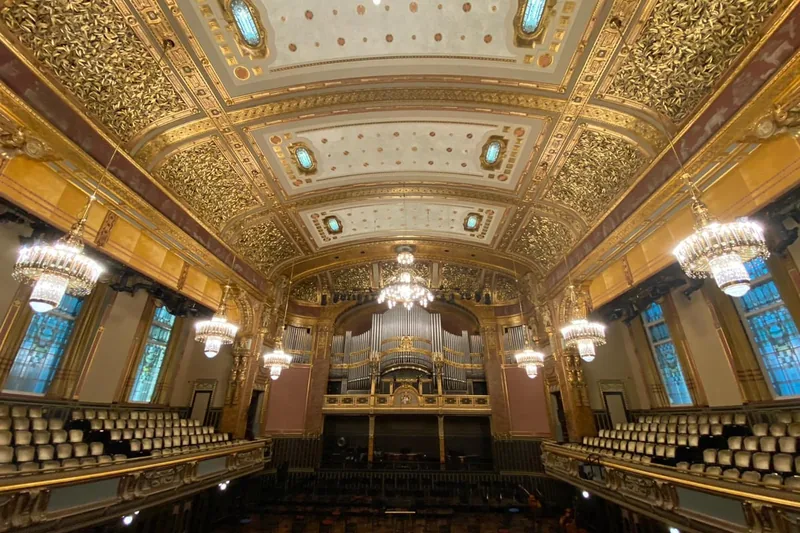
Franz Liszt Academy of Music Guided Tour
- Guided tour of the Liszt Academy
- Grand Hall and György Solti Chamber Hall
- Fountain of Art fresco