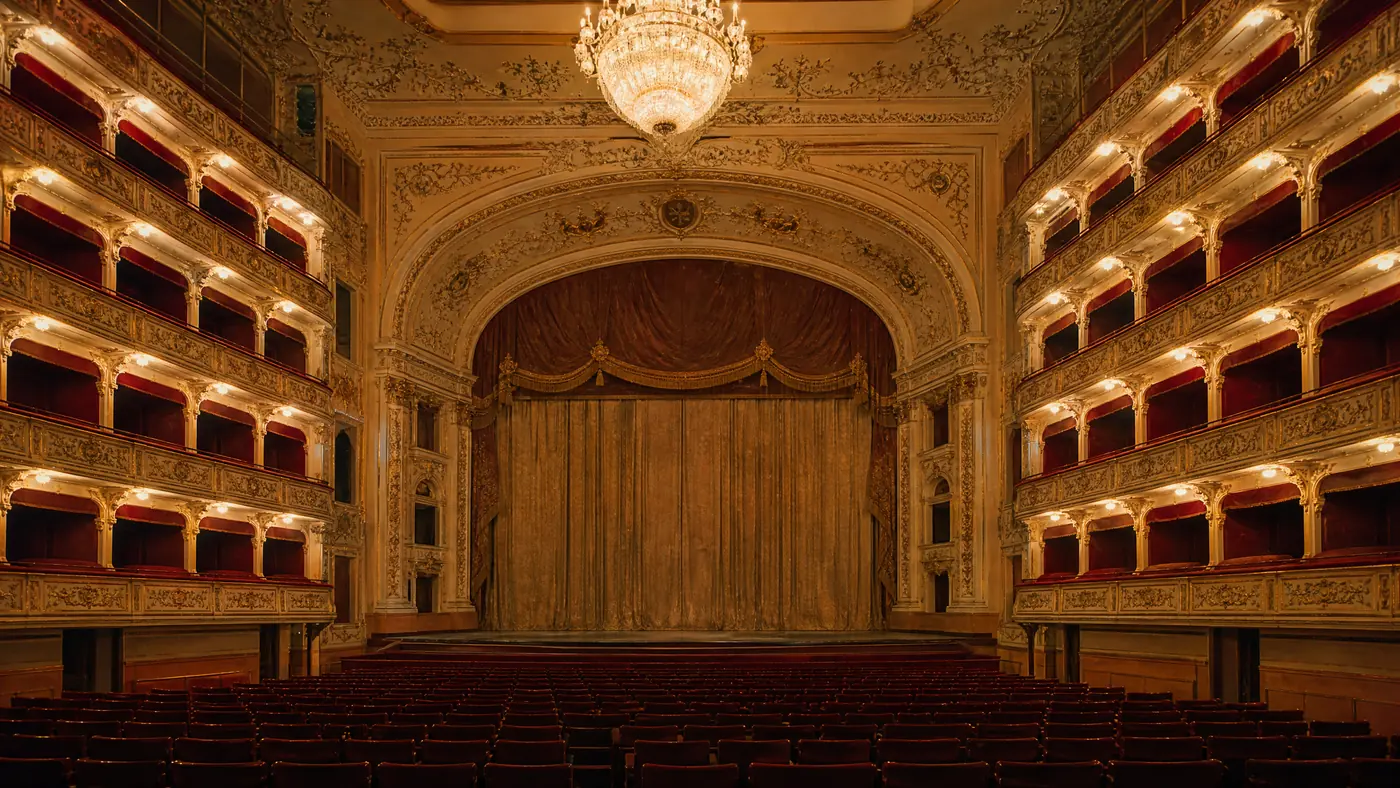
Booking choice: The Heroes' Square and City Park tour, from $46 per person. Check dates Tour details
City Park (Városliget) is a rectangle of about 1,400 by 970 m in District XIV, between Hungária körút, Ajtósi Dürer sor, Vágány utca and Dózsa György út, according to Wikipedia. Its main entrance is Heroes' Square (Hősök tere), at the top of Andrássy út. The park itself is free, and so are the new buildings of the Liget Budapest Project to walk into, the House of Music among them.
Below you will find what each sight is and what it costs to go in, then a route for half a day and the tours on this site that cover the park.
The quick answer
Start at Heroes' Square, with the Museum of Fine Arts and the Hall of Art on either side. Walk past the Museum of Ethnography to the House of Music, then on to the lake and Vajdahunyad Castle. Finish at the Széchenyi Thermal Bath, with the zoo next door. The guided Heroes' Square and City Park walk covers the same ground in about two hours.
What is City Park in Budapest?
One of the first public parks in the world, laid out from 1751 and the main venue of Hungary's millennium celebrations in 1896. Today it is the city's museum and leisure park.
The land was once Ökör-dűlő, the Oxmeadow, Wikipedia says, first mentioned in 1241. Trees and planned walkways came in 1751, and after the public park was created in the early 19th century it took the name Városliget, the city grove. In 1896 it hosted the millennium celebrations, by which time Andrássy út and the Millennium Underground had been built.
The Liget Budapest Project has added new buildings and renovated old ones. The House of Music opened in January 2022 and the Museum of Ethnography on 23 May 2022. Liget Budapest is also pushing car traffic out of the park and cutting back asphalt, keeping only what cyclists, people with prams, wheelchair users and walkers need.
| Sight | What it is | Entry |
|---|---|---|
| Heroes' Square | Millennium Monument and colonnades | Free, open square |
| Museum of Fine Arts | European art from ancient Egypt to the 18th century | Ticket |
| Museum of Ethnography | Folk culture museum with a walkable roof garden | Roof and Visitor Center free; exhibitions ticketed |
| House of Music Hungary | Music museum and concert venue by Sou Fujimoto | Building free; exhibitions ticketed |
| Vajdahunyad Castle | Castle complex from 1896, rebuilt in stone | Courtyard free; museum ticketed |
| City Park lake | Boating lake in summer, ice rink in winter | Rink ticketed |
| Széchenyi Thermal Bath | Neo-baroque bath with outdoor pools | Ticket |
| Budapest Zoo | Zoo and botanical garden, opened 1866 | Ticket |
What is on Heroes' Square?
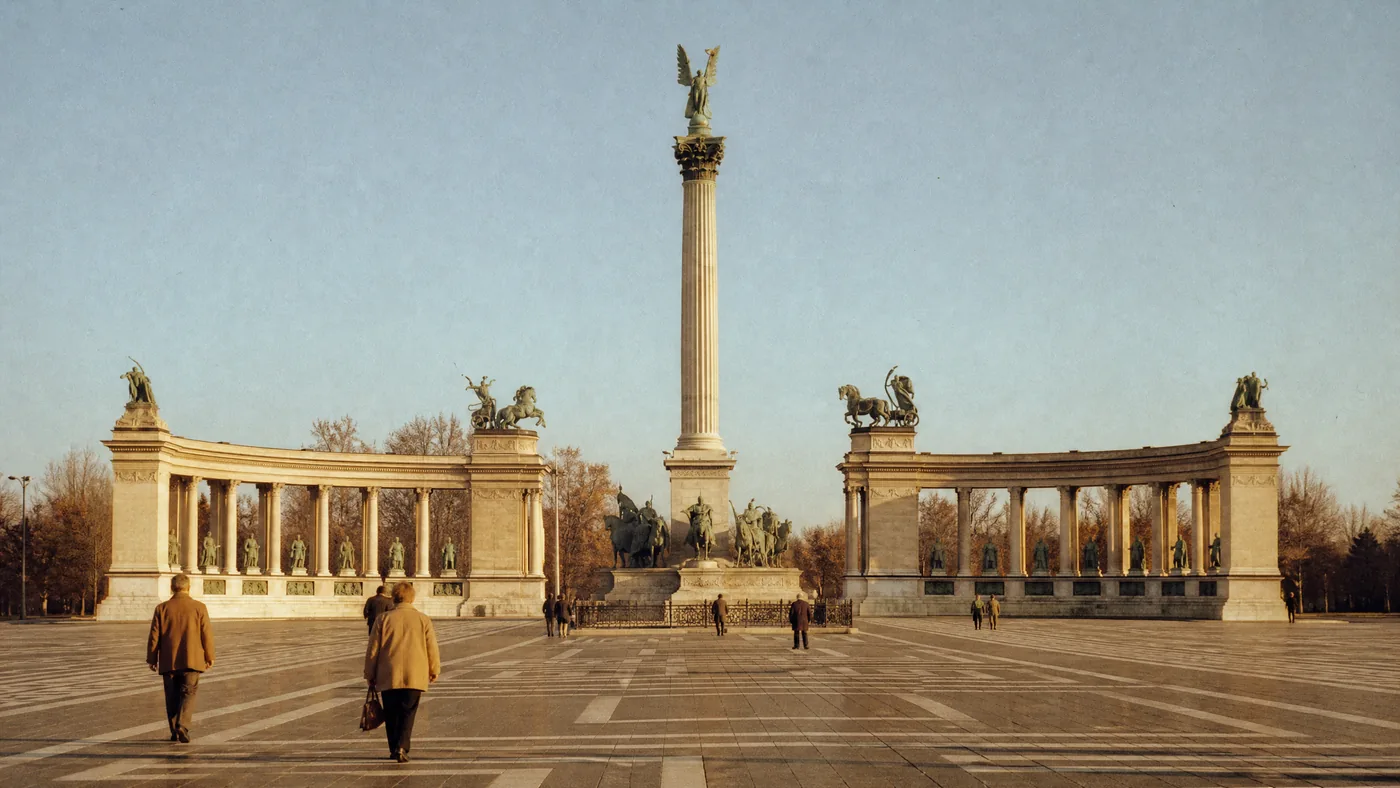
The Millennium Monument: a 36 m column with the Archangel Gabriel, the seven Magyar chieftains on horseback, and two colonnades of Hungarian rulers. The Museum of Fine Arts and the Hall of Art flank it.
Work on the monument began in 1896, for the thousandth anniversary of the Hungarian conquest, and was mostly done by 1900, Wikipedia says. The square has had its present name since 1932 and is part of the World Heritage site with Andrássy út.
- The column: Corinthian, 36 m tall. On top stands György Zala's Archangel Gabriel, 4.8 m of bronze holding the Holy Crown and the apostolic double cross. It won the Grand Prix at the Paris Exposition of 1900.
- The chieftains: Árpád leads, with Előd, Ond, Kond, Tas, Huba and Töhötöm behind him.
- The colonnades: kings and leaders from Saint Stephen to Lajos Kossuth, each with a bronze relief of a scene from his time.
- The Memorial Stone of Heroes: a cenotaph, not a tomb. Under it lies the artesian well drilled in 1878 by Vilmos Zsigmondy, whose hot water still feeds the Széchenyi Bath.
The angel has been away. Wikipedia notes it came down in 2024 for restoration, the first time in more than 120 years. In March 2026 Liget Budapest reported it was expected back on the column by the end of 2026. Meanwhile a life-size replica stands in the free Guardian Angel of Hungary exhibition at the City Park Visitor Center, inside the Museum of Ethnography, where you can walk right up to it.
The square also saw a turning point of modern history: the reburial of Imre Nagy on 16 June 1989.
The Heroes' Square and City Park walk meets at the Huba statue on Hősök tere and spends its first half hour on the monument and its kings.
Check dates for the Heroes' Square and City Park tourIs the Museum of Fine Arts in City Park worth a visit?
Yes, for European art from ancient Egypt to the 18th century and for the Romanesque Hall, reopened in 2018 after 70 years as a storeroom.
The museum stands on the left of Heroes' Square, behind a temple front of Corinthian columns. Albert Schickedanz and Fülöp Herzog designed it, the same pair behind the Hall of Art and the Millennium Monument, and Franz Joseph I inaugurated it on 1 December 1906, Liget Budapest says.
The holdings run to more than 100,000 works, from mummies and sarcophagi to Renaissance and Baroque masters, Leonardo da Vinci to Rembrandt. The renovation under the Liget Budapest Project brought back the Romanesque Hall, a 900-square-meter space in the style of a medieval basilica. Damaged in the Second World War, it served as a warehouse for seventy years. Seventy restorers worked on nearly 2,500 square meters of its surfaces, using five kilograms of gold.
Give it at least two or three hours, and more if a big temporary show is on. Since its 2018 reopening it has hosted exhibitions on Michelangelo, Cézanne, Bosch, Matisse, El Greco and Renoir.
What is the Museum of Ethnography in City Park?
Hungary's national museum of folk culture, in a new building shaped like two hillsides with a roof garden of over 7,000 square meters. It opened on 23 May 2022.
Marcel Ferencz of NAPUR Architect won the design competition against names such as Zaha Hadid and Rem Koolhaas, Liget Budapest says. The two hillsides meet underground, and the glass facade between them is clad in nearly half a million small pixels, patterned on twenty Hungarian and twenty international folk motifs.
- The roof garden: free, open, and good for a picnic. Walk up the edge for a view over City Park and Heroes' Square.
- The City Park Visitor Center: at the main entrance facing Heroes' Square. Information and tickets for the park's institutions, and a free exhibition on Budapest's urban history.
- The Ceramic Space: a free display of 4,000 objects along the stairs.
- The permanent exhibition: about 3,600 objects in eight themes over more than 3,000 square meters, ticketed.
For a music lover it is the natural neighbor of the House of Music. Wikipedia says the museum keeps 4,500 phonograph cylinders recorded by the composers Béla Bartók and László Lajtha, and the exhibition follows Bartók on his folk-song journeys with a phonograph. The ticket on this site, the Museum of Ethnography entry ticket, gives access to every exhibition; leave backpacks behind.
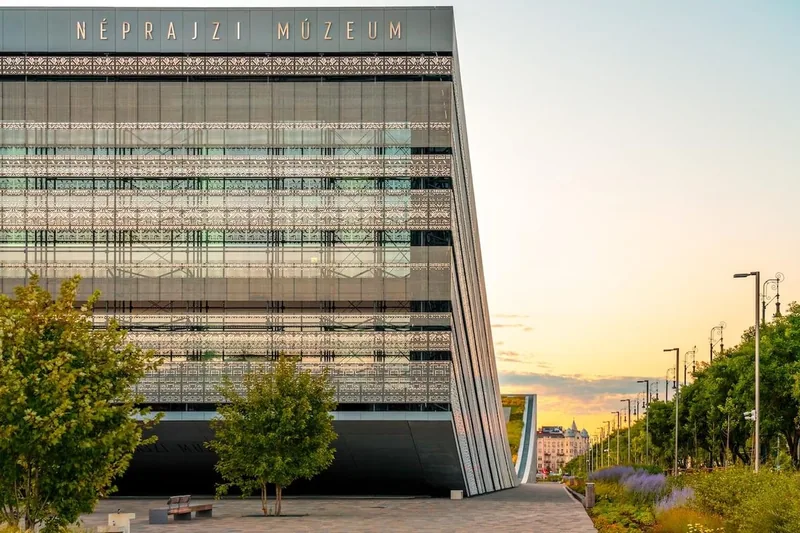
The official entry ticket to the Museum of Ethnography, the House of Music's neighbor: every exhibition, including the folk music archive behind Bartók's phonograph journeys.
Explore the Museum of Ethnography ticket Tour detailsWhat is Vajdahunyad Castle?
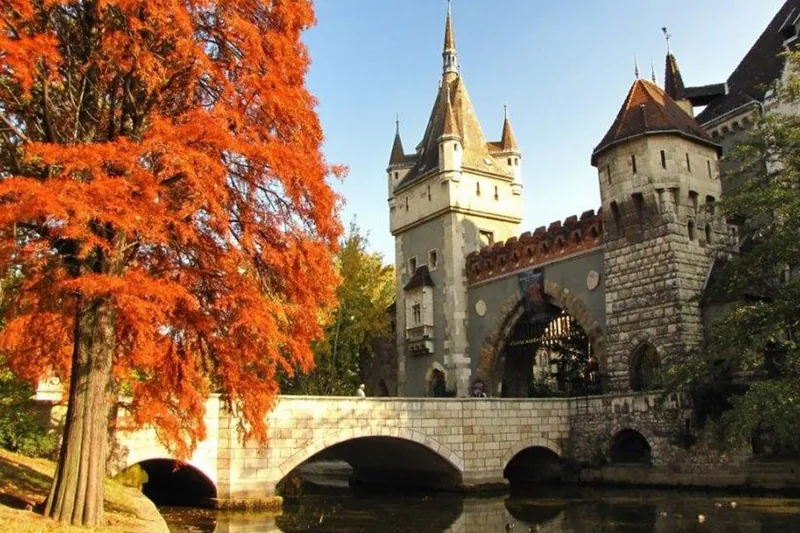
A castle complex built for the 1896 Millennium Exhibition, first in wood and cardboard and then in stone from 1904 to 1908. It mixes Romanesque, Gothic, Renaissance and Baroque styles.
Ignác Alpár designed it as a set of 21 copies of historic Hungarian buildings, Wikipedia says. It was meant to be temporary. Visitors loved it, and Alpár rebuilt it in brick and stone between 1904 and 1908. The main facade copies the castle at Vajdahunyad, now Hunedoara, which gave the whole group its name.
Look for the Ják Chapel, whose portal copies the church at Ják, and for Miklós Ligeti's statue of Anonymus, the unknown chronicler of King Béla III, in the courtyard. The Baroque wing has housed the Museum of Hungarian Agriculture since 1907.
The castle stands beside the City Park lake, close to the House of Music. In summer the lake is for boats. In winter part of it becomes the City Park Ice Rink, open since 1870, which the Heroes' Square tour listing calls Budapest's most popular rink. Skating beside a castle in December is hard to beat.
The City Park true crime walk goes after dark, with an actor-guide dressed as a detective, past the zoo, the Széchenyi Bath and Vajdahunyad Castle.
Check dates for the City Park true crime walkHow far is the Széchenyi Thermal Bath from the House of Music?
A short walk across the park. The bath stands beside the zoo, and the M1 metro stop Széchenyi fürdő is named after it.
The Széchenyi opened in June 1913, built in neo-baroque style to the design of Győző Czigler, Wikipedia says. An extension added the outdoor section in 1927. Today it has 3 outdoor and 15 indoor pools, fed by two thermal springs at 74 and 77 degrees Celsius. The first well is the one under Heroes' Square. The outdoor pools run from 27 to 38 degrees, warm enough for a winter swim in the steam.
The M1 metro stop Széchenyi fürdő is also the one for the House of Music, about 15 minutes' walk through the park. That makes the bath the easy end to a museum day.
What to know before you book the Széchenyi Bath ticket on this site: it is a one-time entry with a locker or a cabin, depending on the option. Children under 14 are not admitted. Bring a towel, swimwear and flip-flops, because renting is not possible on this ticket.
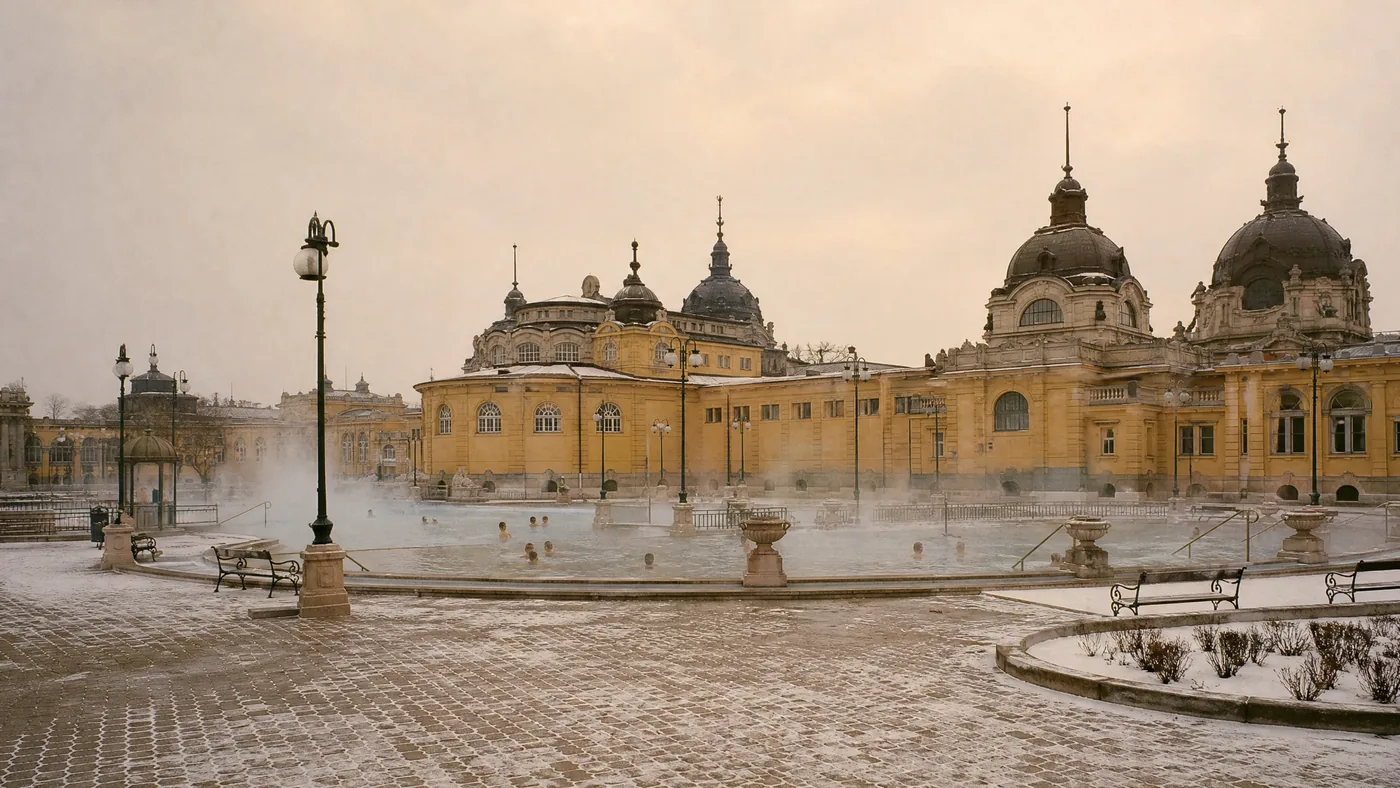

A one-time entry to the Széchenyi Thermal Bath across City Park, with a locker or a cabin: 18 thermal pools after a morning in the museums.
Explore the Széchenyi Bath ticket Tour detailsWhat else is in City Park?
The Budapest Zoo and Botanical Garden, opened in 1866, the Capital Circus, Gundel restaurant and the House of the Hungarian Millennium.
- Budapest Zoo and Botanical Garden: opened on 9 August 1866, the earliest zoo in Hungary. The Main Gate, the Elephant House and the Palm House date from the 1909 to 1912 rebuilding, mostly by Károly Kós and Dezső Zrumeczky, the zoo says. Over a million people visit a year.
- The Capital Circus of Budapest: on the park's edge; Wikipedia dates the first show in the circus building to 1891.
- Gundel: the restaurant the Heroes' Square tour calls Hungary's most famous, on the way to the zoo.
- The House of the Hungarian Millennium: a renovated pavilion that holds the NEO Contemporary Art Space, opened in June 2022, and sells Liget's guided walks.
Liget Budapest also runs its own guided walks in the park, for individuals and groups, with the House of Music as a highlight. Tickets come from the House of the Hungarian Millennium or the City Park Visitor Center.
How do you spend half a day in City Park around the House of Music?
Start at Heroes' Square, walk to the House of Music for an exhibition slot or the guided tour, then the castle and the lake, and finish in the Széchenyi Bath.
Build the day around the one fixed time: your slot at the House of Music. On Tuesday to Thursday, Saturday and Sunday the permanent exhibition takes its last visitors at 16:15, and on Friday at 17:45. Everything else on this route has no slot to miss.
| Stop | What to do | Tip |
|---|---|---|
| Heroes' Square | The monument, the kings, the Museum of Fine Arts facade | Arrive on the M1 at Hősök tere |
| Museum of Ethnography | The roof garden, the Visitor Center, the angel replica | Free; pick up park information here |
| House of Music | The golden foyer, then your exhibition slot or the guided tour | Book the exhibition slot with the House in advance |
| Vajdahunyad Castle and the lake | The courtyard, the Ják Chapel, the rink in winter | Lovely at dusk |
| Széchenyi Thermal Bath | The outdoor pools | Bring towel and flip-flops |
Prefer a guide? These tours on this site cover the park. None of them includes a House of Music exhibition ticket.
| Tour | In City Park | Length | From |
|---|---|---|---|
| Heroes' Square and City Park tour | Heroes' Square, Gundel, the zoo, the bath, the castle, the House of Music, ending at the Museum of Ethnography; folk songs by the guide | 2 to 2.5 hours | $46 per person |
| City Park true crime walk | Evening walk from Heroes' Square past the zoo, the bath and the castle; not for under 16 | 105 minutes | $19 per person |
| House of Music guided tour | Inside the House: concert hall and lecture hall | 1 hour | $13 per person |
| Museum of Ethnography ticket | Every exhibition of the museum | Day ticket | $20 per person |
| Széchenyi Bath ticket | One-time entry, locker or cabin | Day ticket | $43 per person |
Our visitor guide to the House of Music has the opening hours, transport and food in the building.
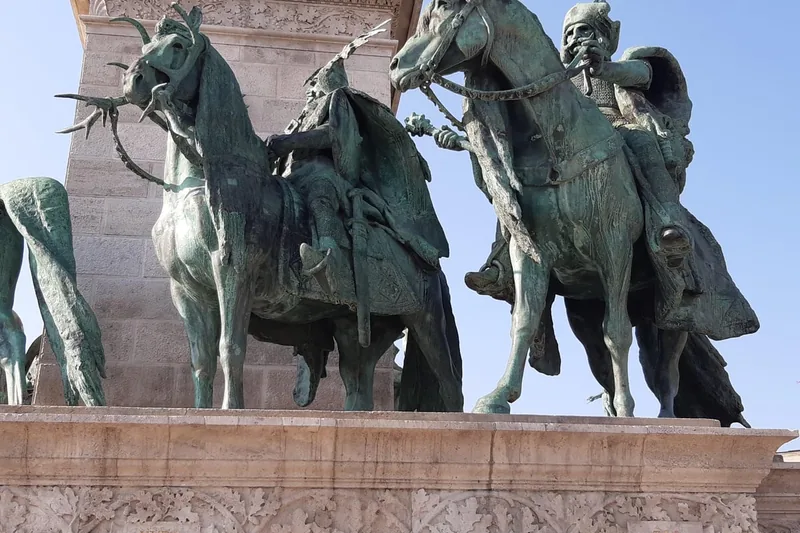
About two hours from the Huba statue on Heroes' Square past Gundel, the zoo, the bath and Vajdahunyad Castle to the House of Music, ending with Hungarian folk songs and dance steps from your guide.
Explore the Heroes' Square and City Park tour Tour detailsFrequently asked questions
Is City Park in Budapest free?
Yes. The park, Heroes' Square, the roof garden of the Museum of Ethnography and the foyer of the House of Music cost nothing. You pay for museum exhibitions, the bath, the zoo and the ice rink.
How do you get to City Park?
Take the M1 yellow metro to Hősök tere for Heroes' Square or to Széchenyi fürdő for the bath. For the House of Music, trolleybus 70 stops closest, at Olof Palme sétány.
Where is the Archangel Gabriel statue?
It was taken down from the column on Heroes' Square for restoration in 2024. Liget Budapest expected it back by the end of 2026; a life-size replica is on show at the City Park Visitor Center.
What is the best tour of City Park?
The Heroes' Square and City Park tour covers the square, the zoo, the bath, Vajdahunyad Castle and the House of Music in about two hours. For an evening walk, take the true crime tour.
Ready to book
Choose your tour
Free cancellation up to 24 hours before on every option. Prices are from-prices in USD and move with the season.
Heroes' Square and City Park Tour with Music
The park around the House, with a folk tune on the way
City Park True Crime Walking Tour
City Park after dark, with true stories told by an actor
Széchenyi Thermal Bath Ticket
The thermal bath a short walk across the park